
 Dataset
Abstract
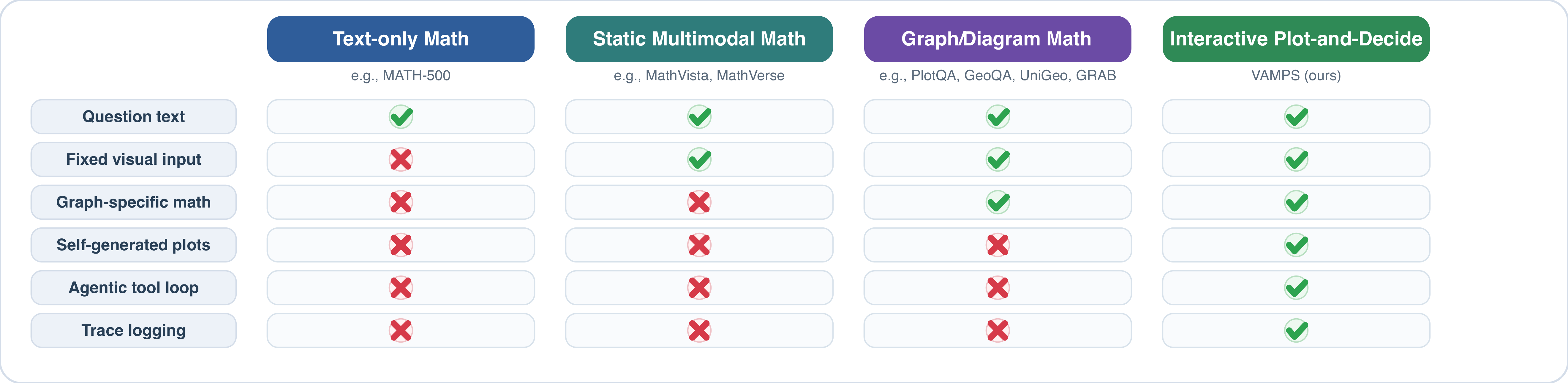
We introduce VAMPS (Visual-Assisted Mathematical Problem Solving), a benchmark for graph-assisted mathematics. It contains 1,168 multimodal, bilingual multiple-choice pairs from the Iranian University Entrance Exam (Konkour) and human-reviewed synthetic variants, curated so that plotting reveals intersections, extrema, asymptotes, and related structure.
VAMPS tests whether models can construct a useful graph via Desmos and ground their answer in the resulting visualization. Across a diverse set of models, direct analytical solving surprisingly outperforms tool-enabled visual solving, even on problems where plotting is a natural strategy.
Benchmark
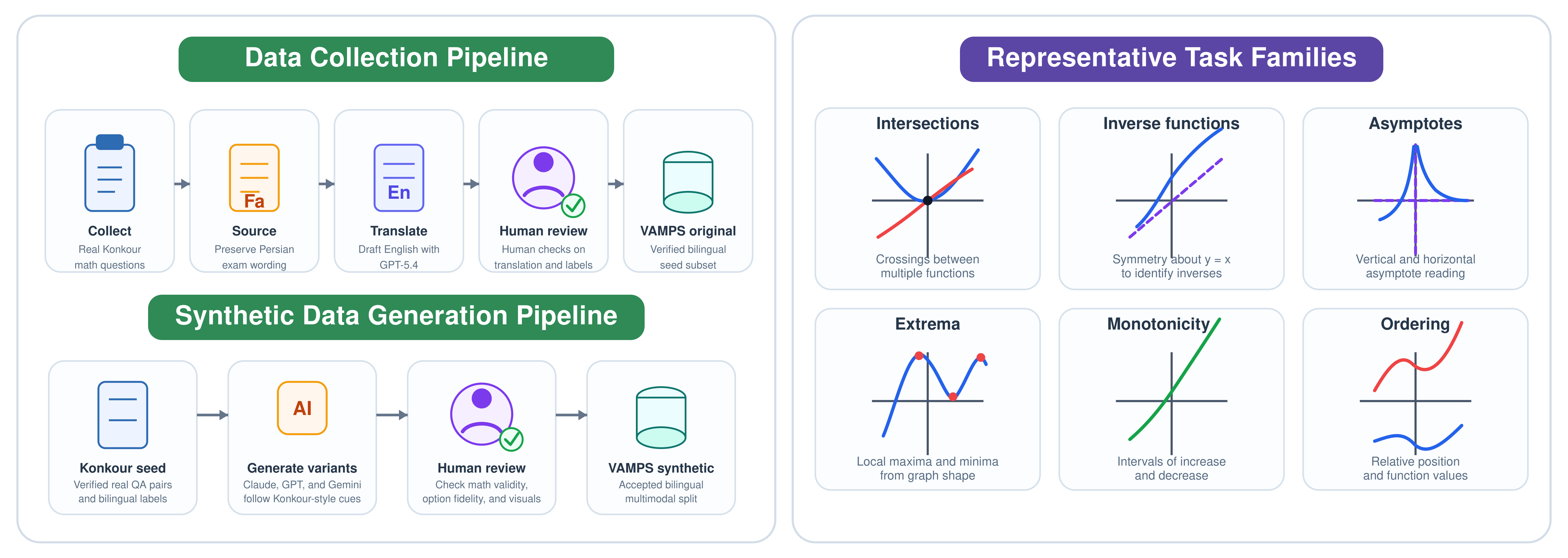
218 seed questions from the Iranian University Entrance Exam (Konkour, 2016–2023) are manually verified in Persian and English, then expanded with human-reviewed synthetic variants. Each item is a 4-option MCQ where graphing is a natural solution strategy.
Synthetic variants were generated with Claude Opus 4.7, GPT-5.4, and Gemini 3.1 Pro, then human-reviewed for mathematical validity. Konkour English translations use GPT-5.4.
Question Samples
Illustrative R2 trajectories from the paper (Claude Opus 4.7 on Konkour English items).
Solving Regimes
Three complementary regimes isolate analytical reasoning, tool-mediated plot construction, and visual interpretation.
desmos_plot with auditable screenshots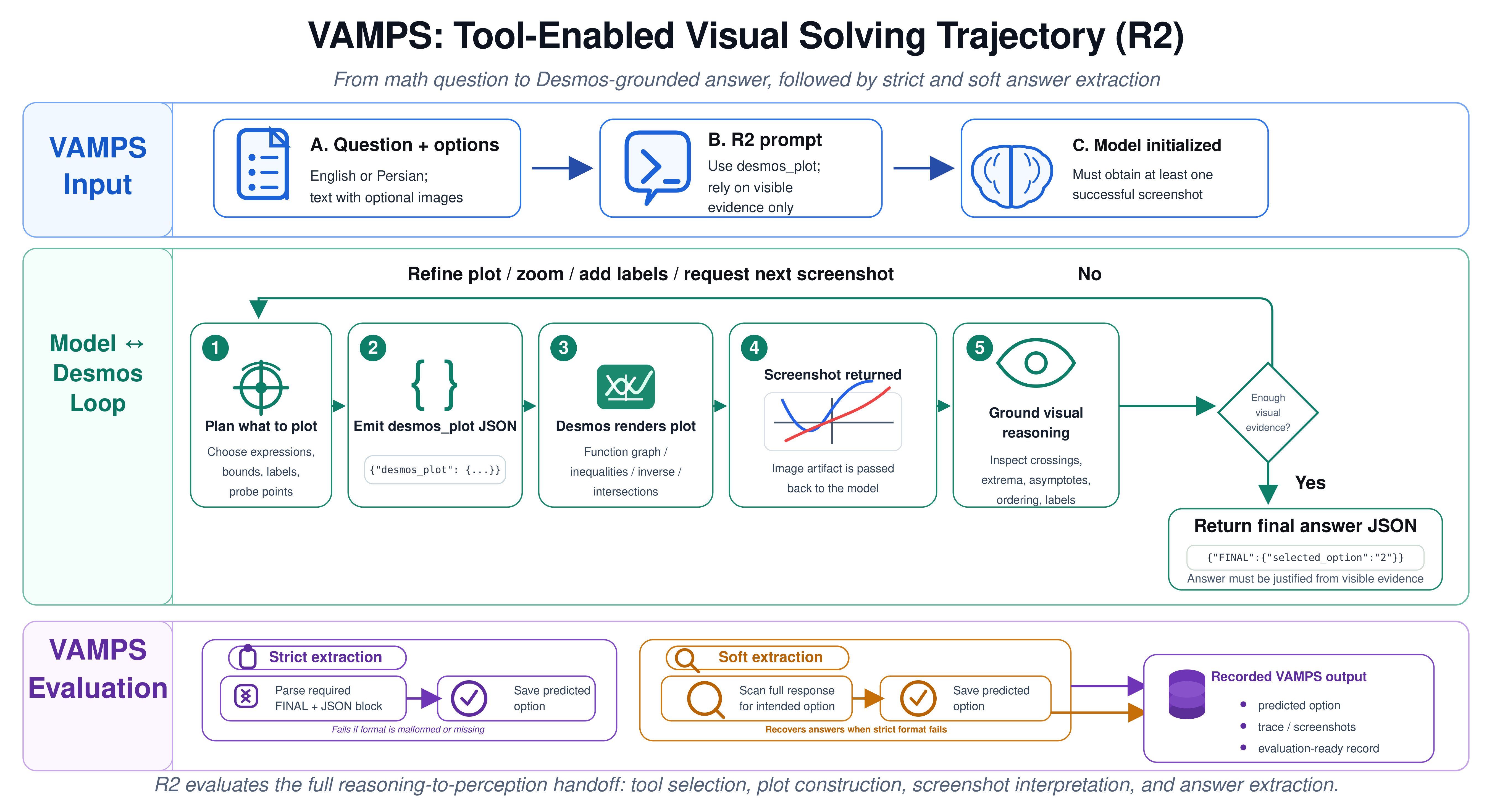
Results
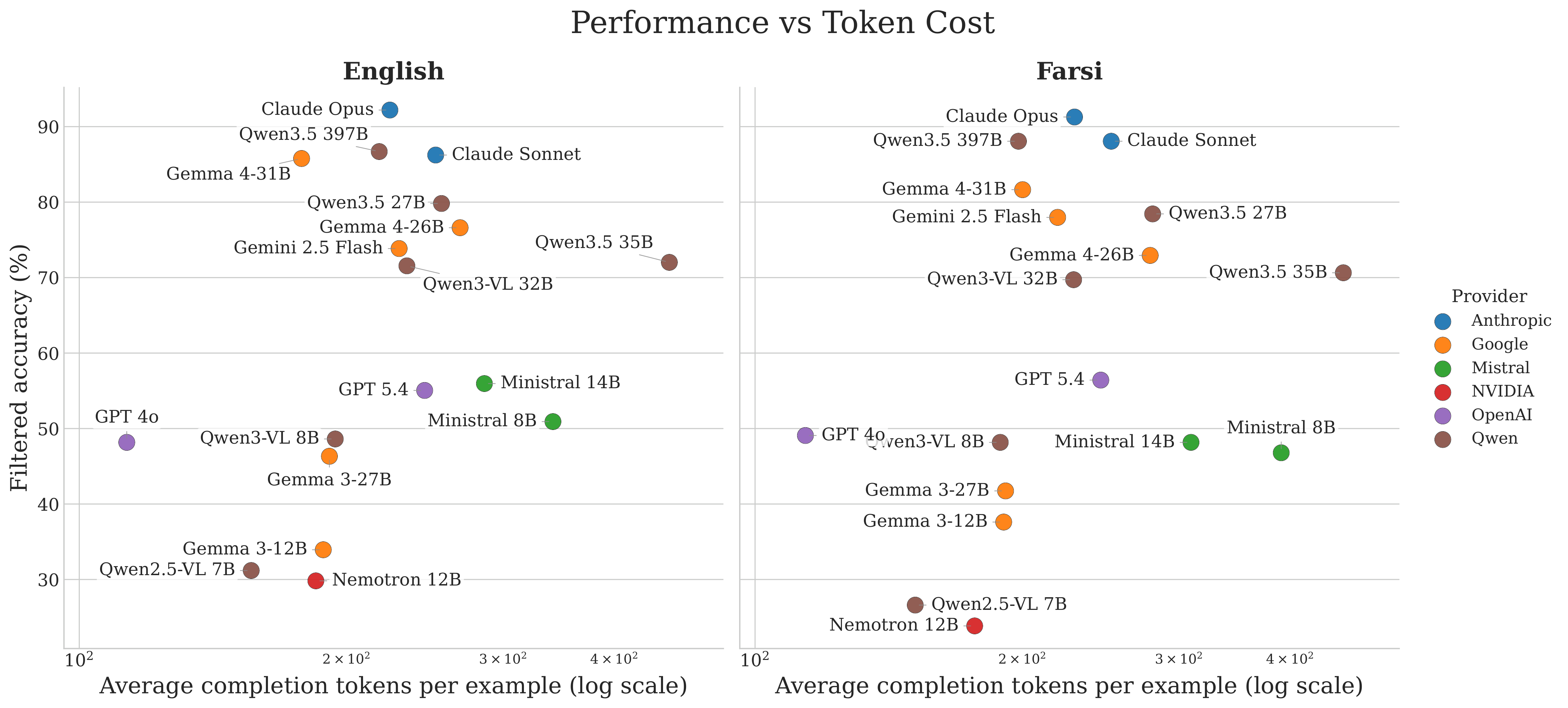
On the Konkour subset, R1 analytical solving consistently beats R2 tool-enabled solving. Claude Opus 4.7 leads across all regimes; GPT-5.4 drops 23+ points from R1 to R2 despite strong symbolic ability.
Tools can hurt
GPT-5.4: 89.0% R1 → 66.5% R2 (English). Qwen3-VL 8B: 92.2% → 50.0%.
R3 < R1 for strong models
Gemma4 31B: 97.2% analytical vs. 88.0% with provided visualizations.
Reasoning-to-perception gap
Failures span malformed tool calls, auto-label over-trust, and misread plot windows.
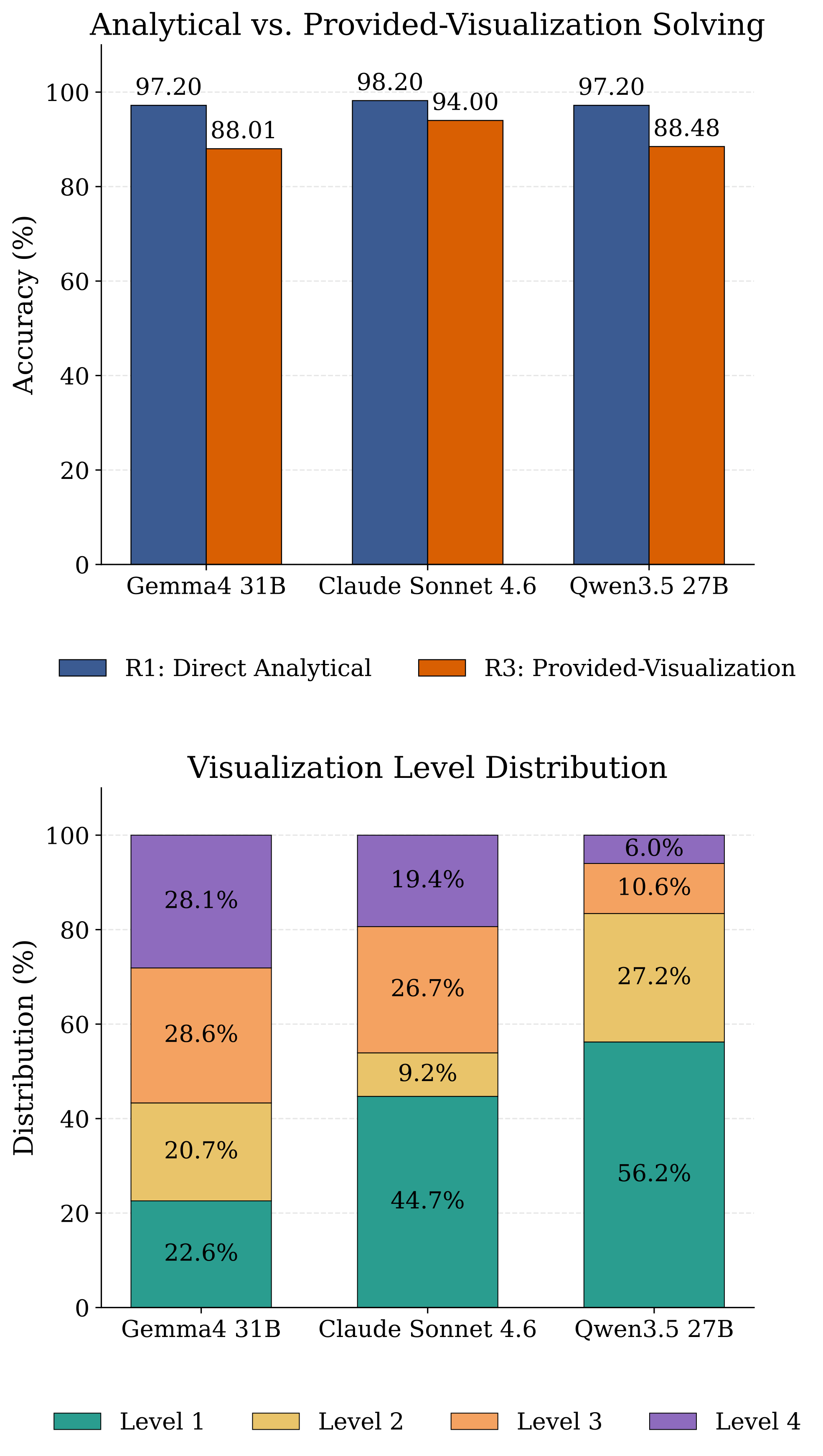
Leaderboard
Konkour subset accuracy for all 18 evaluated models. Judge = VLM-as-judge filtered R2 accuracy.
| # | Model | Regime Profile | R1 Analytical (English) |
|---|
Citation
@misc{dabiriaghdam2026vamps,
  title={VAMPS: Visual-Assisted Mathematical Problem Solving Benchmark},
  author={Amirhossein Dabiriaghdam and Shayan Vassef and Mohammadreza Bakhtiari and Yasamin Medghalchi and Ilker Hacihaliloglu and Mesrob Ohannessian and Lele Wang and Giuseppe Carenini},
  year={2026},
  eprint={2606.04244},
  archivePrefix={arXiv},
  primaryClass={cs.AI},
  url={https://arxiv.org/abs/2606.04244}
}